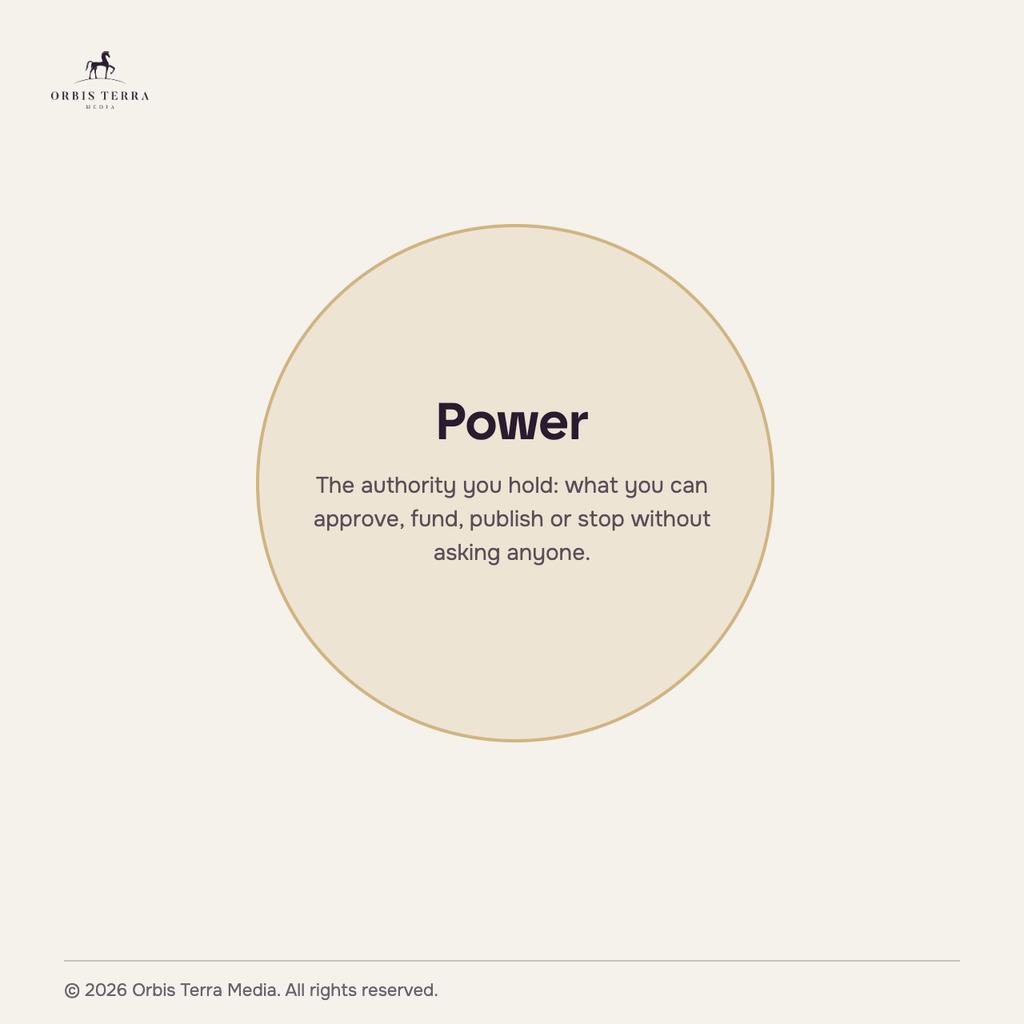
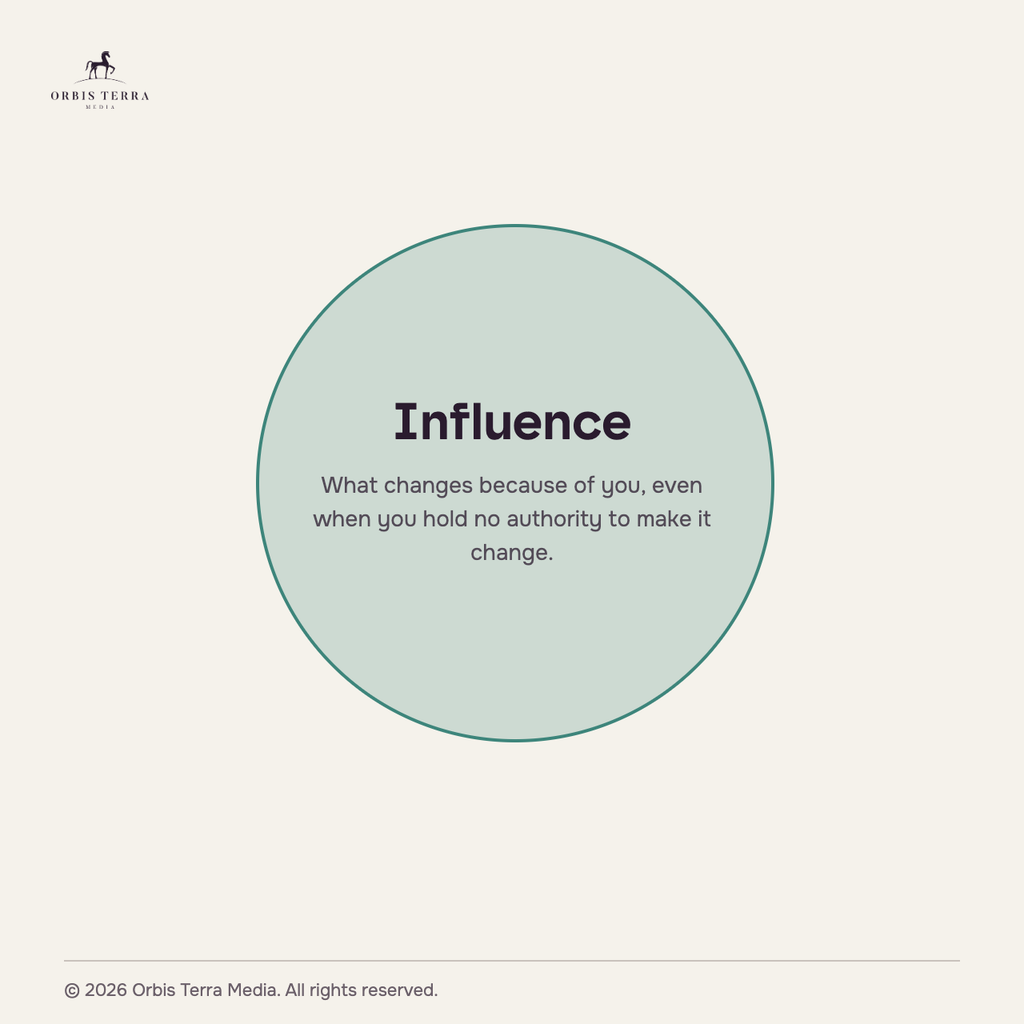
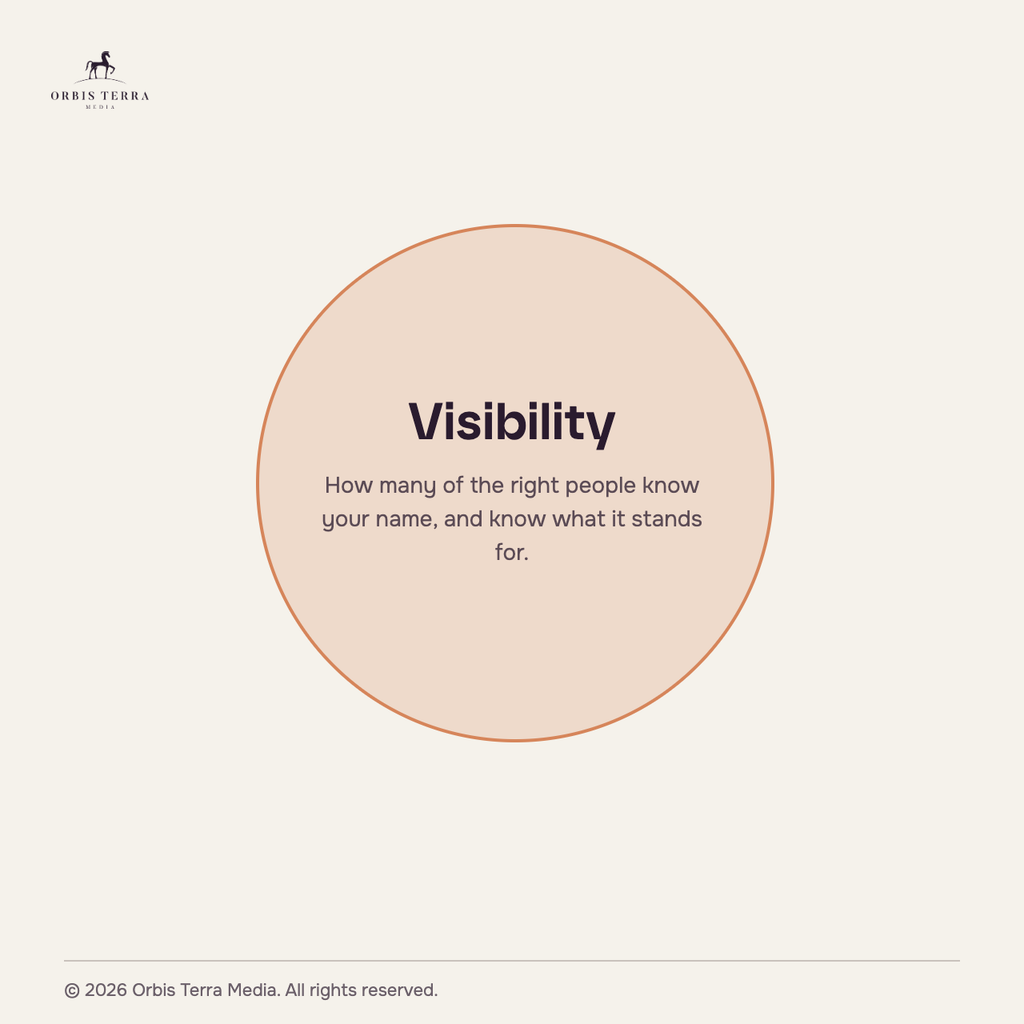
Power, influence and visibility are three different things, and most of the leaders we work with measure their own success by only one of them. Power is direct: it designates you as the decision-maker others must follow, and it is not up for debate. Influence is different because it makes people want to behave as you wish, and it depends on carrying conviction rather than holding a title. Visibility is how much you are actually seen, by the audience you care about, which is not the same as how many people in total have heard of you. Everyone holds some mixture of the three. The mixture that will make you feel successful, and actually be successful, is different for every person, it is not static, and there is no correct ratio to aim for.
Here is the framework we use with our clients to find out whether they are known for what they actually want to be known for, or simply for whatever their current mixture happens to produce.
Where did this framework come from?
It came out of years working with clients on personal branding and noticing how differently people measure success around how their name is recognised. We wanted a concept that could do two things: measure the gap between where someone is and where they want to be, and measure success once a positioning and a strategy are in place. Power, influence and visibility do both, because they describe a current state and a target state in the same three terms.
The reason we separate them, rather than talk about “profile” or “reputation” as one blurred idea, is that people constantly conflate them. Something that gives you visibility does not automatically give you influence. It can, but not on its own. Someone can hold real power and wield very little influence. Everyone has a different natural balance of the three, shaped by the roles and activities they choose, and when your current roles do not reflect the balance you actually want, that mismatch is usually a sign you have not been fully honest with yourself about where you stand, what you want, or how you are actually perceived.
A shortage of any one of the three tends to show up as frustration, even when the person carrying it would not describe it that way.
What do power, influence and visibility actually mean?
The three forces, defined precisely enough to use:
- Power — direct, not up for debate. It designates you as the decision-maker others must follow.
- Influence — it makes people want to behave as you wish. It requires carrying conviction, and a title alone does not supply it.
- Visibility — how much you are actually seen, by the audience you care about, online or offline. This is the trap term, because people default to equating it with follower counts. It is really about the rooms that matter to you, and whether, when you walk into them, people recognise you, listen to you, and defer to you. Context is everything: visibility in one room does not transfer to the next.
How does the framework actually run?
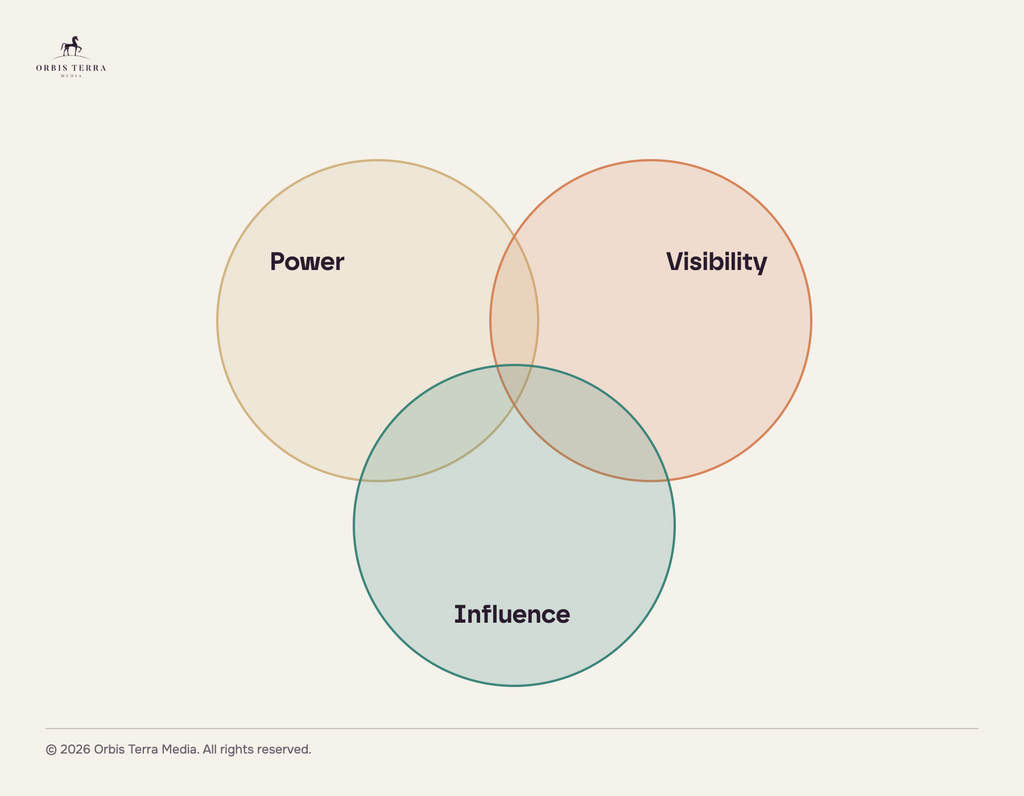
It is not a question of naming what is missing, because everyone has all three to some extent. In session it runs as a Venn diagram of the three forces, and the exercise is to place your current roles and activities into it — a job title, a volunteer role, being a thought leader, leading an association, anything that currently occupies your time and attention — then ask of each one: does this give me power, influence or visibility, over whom and to what degree? It runs as a single structured conversation, usually under two hours, which is shorter than most people expect once they are actually in it.
What does getting the balance wrong actually look like?
A recurring pattern we see: clients who are exceptionally good at what they do fall into a humility trap, where there is a felt shame in wanting visibility at all. Very often someone has real influence, even real power, but little visibility, and while that is fine if they are genuinely content with it, for most it is a quiet frustration that manifests as doing extraordinary, genuinely impactful work that goes almost entirely unknown, sometimes even to the people it was done for. None of this is about fame. Much of our work with already-successful people is getting them past the idea that wanting to be seen is a vanity metric rather than a legitimate part of doing the work well.
The inverse shows up too, often in family businesses specifically: someone holds a high-level title, real power on paper, but does not carry the influence that title is supposed to imply. The title does not guarantee that conviction follows it, and a room will notice the gap before the person holding the title does.
A room will notice the gap before the person holding the title does.
What do people get wrong about their own balance?
The most common error we see is gauging all three against the wrong audience, or against no audience at all. If the implicit audience is “everyone”, the exercise is doomed from the start, because none of us are visible, influential or powerful to everyone. The real question is always visible to whom, influence over whom, power over what. Getting clear on that alone can shift where your circles sit, without changing a single decision about your career.
The real question is always visible to whom, influence over whom, power over what.
More than a factual mistake, it is a difficulty being honest. People lie to themselves about what the balance should be, and an unexamined morality gets in the way: is it wrong to want power, vain to want visibility, underhand to want influence? That hesitation is feeds into a trap: you cannot claim you want impact and then deny that impact requires leaning into your actual strengths and finding your real balance across the three. It is not only about impact, either. It is about your own satisfaction, because pretending to be content with less power, less influence or less visibility than you actually want leads, reliably, to frustration.
What should you actually ask yourself?
These are the diagnostic questions, in the order we use them:
- List your current roles and activities (a job title, a board seat, volunteer work, speaking engagements, leading an association) and place each on the balance. Does it give you power, influence or visibility, and roughly how much of each?
- For each one, ask specifically: visible to whom, carrying influence over whom, holding power over what? “Everyone” is not an answer. That is fame, and it is a different thing from what is being measured here.
- Is this the balance you actually want, or the one your current roles happened to hand you?
- If the honest answer is no, what would have to change? Not necessarily the work itself, but what you say about it, to whom, and how often?
- Is there a moral hesitation sitting underneath your answer? A sense that wanting more visibility is vain, more power is uncomfortable, more influence is somehow underhanded? Name it specifically, because it is usually the actual obstacle, not the roles themselves.
So, are you known for what you want to be known for?
That is the core question, and the balance of power, influence and visibility is one of the clearest ways we know to answer it. Look at your own name and ask, honestly, to what extent it currently carries each of the three: all matter for creating impact and for getting what you actually want. The tone worth taking with yourself is honest without being self-flagellating. Are you lying to yourself, and why, and is a limiting belief what is actually holding this back rather than any real constraint? In practice, these things are fixable, and the first step is being willing to look at the imbalance rather than explain it away.
Are you known for what you want to be known for?
If this diagnostic has surfaced more questions than it has answered, that is usually where our Personal Branding Journey actually starts. Further reading: how personal branding empowers leaders in a complex world and what I have learned from working with leaders on their personal brand.
Enjoyed this? Subscribe to Our Voice for the next piece in this series.


