We launched a family business magazine in 2008, which turned out to be the worst year in living memory to launch anything funded by corporate marketing budgets. Banks were failing while we were finalising the first issue. Several of the companies we profiled were fighting for survival by the time their piece ran.
Eighteen years later we are still publishing, which is either one lesson or a long series of them.
I have been asked what we learned often enough that it seems worth writing down properly. Some of it is specific to publishing. Most of it applies to anybody trying to build an audience that will still be there in a decade.
Lesson #1 – Going niche was the key
When we launched Tharawat Magazine, the decision to focus exclusively on family businesses was not born out of a strategy to find a niche we could exploit. It was because it was a passion that developed naturally from our experiences within our own family business as well as a topic which we believed was relevant to many people and grossly underserved.
What we have discovered with time is that staying true to that niche has been a solid editorial strategy for us. There is so much generic content out there that we were able to claim some territory in this specific space. That is why we intend to remain very much focused on it as we go forward. The lesson is: it is better to create a big win in a small space than to try to be yet another voice in a vast sea of generic content.
Lesson #2 – Publishing has become a technology game
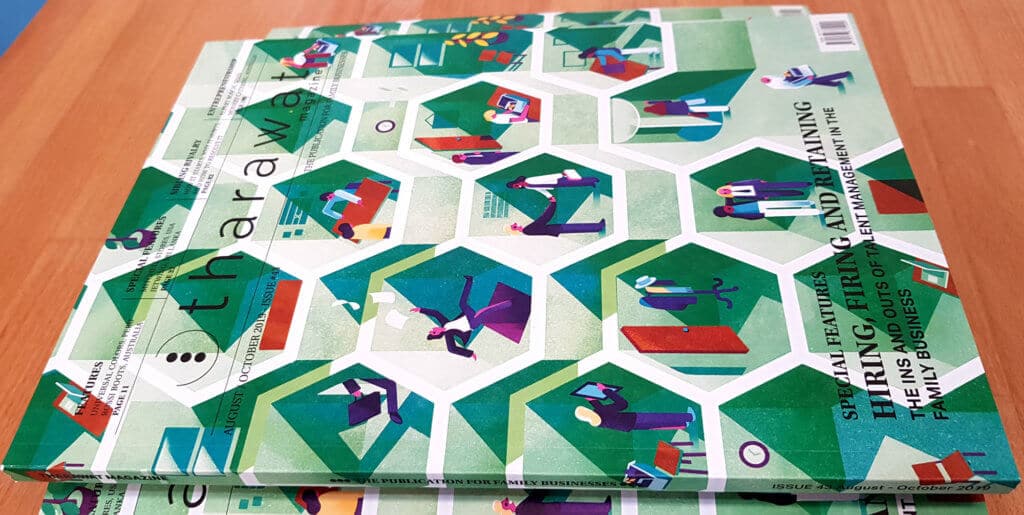
There are few things more satisfying than holding that freshly printed copy of our latest quarterly magazine. Anyone who has put in the hours, sweat and tears to make it a reality knows what I am talking about. And it is easy to focus exclusively on that physical entity that is the print magazine, but that would be a mistake. We knew that even before discontinuing our print run in 2020.
Today, you have to have an omnichannel strategy for your title and make sure that its content reaches people in various forms. That means reaching an audience through print, online, podcasts and social media, and that’s just the beginning. Tharawat Magazine is a content brand that can travel across whichever device people decide to use to consume the content. That was an important lesson to learn: there is no betrayal of your magazine in giving it different formats and using different channels.
During a difficult period, when new brands used republishing to drive traffic to them, we stuck out a much more expensive strategy of original content production.
Lesson #3 – Deliver meaningful content by combining editorial vision with reader data
It is not difficult to choose an editorial vision and execute it. The tricky part is doing it while at the same time delivering information that people want and need. Doing both simultaneously is the driving force behind our editorial strategy.
During a difficult period, when new brands used republishing to drive traffic to them, we stuck out a much more expensive strategy of original content production. This was essentially a two-pronged approach where we sought out people with unique stories to tell that have not always been given a voice. At the same time, we let the data inform us on what the reader is craving so we can give them what they are looking for in a meaningful fashion.
Lesson #4 – Live by the 80/20 rule
This rule states that you should put four times more effort into distributing the content than producing it. It can seem counterintuitive because, as publishers, we tend to fall in love with the process of producing content; but it’s a rule for a reason
We learned the hard way that our most important task was distributing and marketing our articles and podcasts to our audience. There is little point in creating amazing content if, in the end, nobody sees it. So, we continue to scale that up, always looking for new and better ways to reach a global audience. Which brings me to the final lesson…
Lesson #5 – Good content is global content
In the course of producing the magazine in all forms, what has come through very clearly is that good content is global content, and even regional issues can be relevant to a global audience. So, even if you have a regional title, you will want to set a global standard as to how you tackle your topics.
Great content transcends borders; if it is well researched and well written, it will be of interest to anyone, anywhere in the world. That is the standard that we set for ourselves because we understood early on that our readers can be anyone – you never know who will come across your magazine and who could become your next big brand ambassador.
Ultimately, what keeps us going here at Tharawat Magazine is the simple fact that we love what we do. So, while we can’t always do what we like most and there are still many more lessons to learn, we are driven by a passion for creating family business content that can travel across channels and geographies.


